

Fincrime rates have been on the rise since COVID, psychological APP fraud is now one of the most common issues, and AI-assisted scams are becoming more sophisticated and harder to detect.
This means that when working with a legacy system often siloed between departments, you are likely finding your existing fraud management solution is unable to keep up.
But the needs of an enterprise bank are specific.
Systems must be simple to implement, offer multi-rail protection, and be able to track patterns across the full scope of a customer account. All while dealing with multiple and scaling separate departments.
To help you find the right platform for your business, we’re exploring the features to look for in an enterprise fraud management (EFM) system, when it makes sense to use one, and how Vyntra can help.
Want an enterprise fraud management system that helps you stay ahead of financial crime across payment rails? Get in touch with us to book a demo.
In this article
When does it make sense to implement an enterprise fraud solution?
You’ve likely been seeing that new scammer tactics are emerging that are more complex and built to get around legacy binary detection systems. In 2025, these rates surged, causing $4.4 trillion in illicit financial activity around the world.
At the same time, transaction volumes are rising, and real-time payments have reduced the window for fraud detection interception. As a result, almost all banks face a need to evolve their existing fraud management systems.
While implementing a new enterprise fraud management system can make sense in a lot of cases, these are three that you may be currently facing:
You’re managing multiple siloed systems from previous or upcoming acquisitions/mergers
Acquisitions and mergers are standard for many enterprise banks. However, the result can often be legacy systems that work in isolation from one another. These departments do not communicate, and information is not shared across silos.
Finding a way to communicate between these systems is not only difficult, but can also become extremely cumbersome for your processes. It requires ripping out and rebuilding fraud management from the ground up, with risks of interrupting existing systems and causing issues for your customers.
However, finding ways to create visibility across these separate and legacy departments has become essential for fighting fincrime.
In the past, scams would be detected using binary pass/fail tests. For example, whether a transaction was higher than a set amount, came from a new device, or matched a known fraud pattern on a blocklist. These rules-based checks were able to defend against predictable, repeatable fraud, but they struggle when it comes to newer, more sophisticated types of fraud.
That’s because these scams are designed specifically to overcome the pass/fail checks. They’re sophisticated enough to bypass the traditional tests and instead need an enterprise fraud management system that can detect risk indicators and patterns across departments.
For instance, psychologically authorised push payment (APP) scams can easily get through binary detection methods. A victim of a love scam will knowingly send a payment to a mule account, passing any binary identity, device, or credential checks. If all the fraud management system does is ask if the real user is sending the money, then it will fail to detect the actual scam.
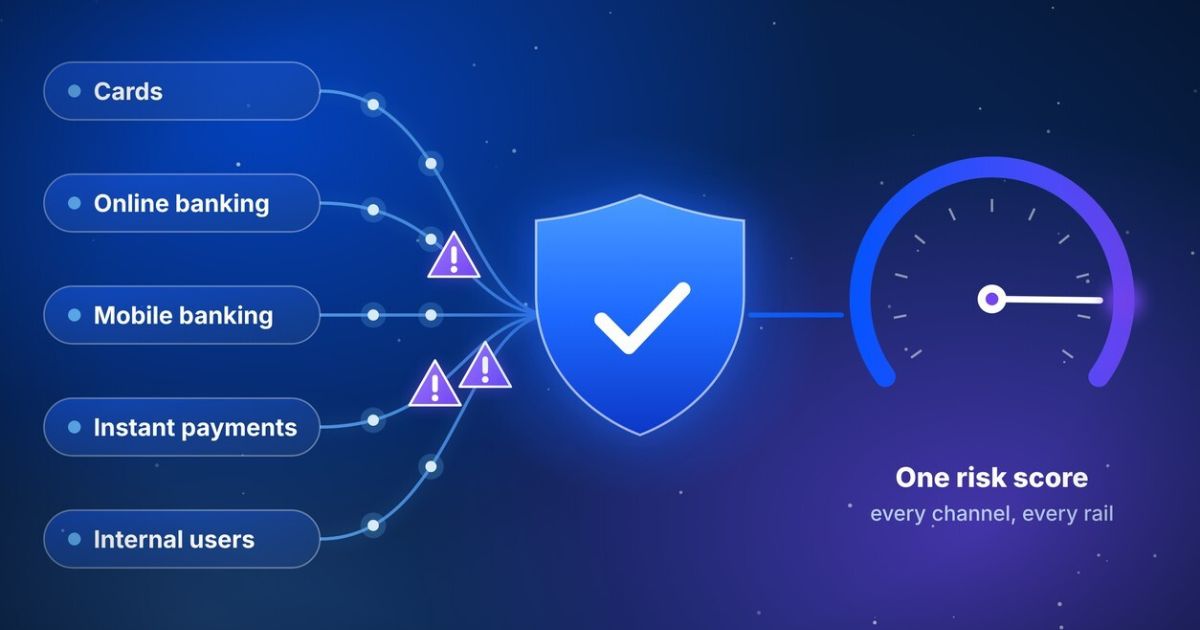
To counteract this, modern fraud detection techniques use a multi-rail approach to detect fraud. Instead of relying on singular siloed risk indicators, systems analyse every stage of the transaction in real-time, then compare them for one comprehensive risk score.
So, in the case of APP fraud, they can use behavioural profiling to detect if the user is acting abnormally, check against a fraud consortium for known signs of a fake account receiving the money, and look through the receiving account’s transaction history for other risk flags. The software compares all these factors, then generates a comprehensive risk score in under a second that determines whether the transaction could be fraudulent.
You’ve found that building an in-house solution is taking too much time or money
Enterprise fraud management is incredibly complex, with the detection techniques needing to be changed and adapted all the time. Building an in-house solution from scratch requires significant time, money, and access to expertise, and by the time you have a working system, it may already need updating.
These updates require ongoing investment in data science, model tuning, and maintenance, costing banks an average of 70% of the IT budget. In practice, that means a dedicated team retraining models as customer behaviour shifts and new types of fraud emerge, like improving deepfake-assisted impersonation scams.
Plus, every moment invested in building an in-house fraud management tool leaves your current systems vulnerable to modern and evolving scams. The stakes are very high, and with real-time payments and sophisticated AI-assisted scams, the margin of error is typically too small for DIY solutions.
Meanwhile, there are out-of-the-box solutions that can be implemented within weeks or months and draw from extensive fraud management-specific experience.
There’s already been a case of internal fraud at your bank, and you want to avoid another
Internal fraud is a risk that doesn’t often get talked about but happens a lot more than we think. But many banks wait until it is too late to implement a true solution.
An instance of internal fraud can lead to a loss of money (sometimes significant funds) for the bank, as well as a drop in user trust. If your customers believe a bank is unable to prevent internal crime, they are likely to lose confidence that their personal savings are safe.
Examples of internal fraud might be:
- Embezzlement: An employee diverting funds to their own account
- Collusion: An insider working with an outside party (or another employee) to bypass controls
- Abuse of admin/privileged access: IT staff misusing super-user profiles
- Unauthorised account/data changes: Modifying customer account details to enable fraud
- Data leaks: An employee extracting customer data to sell or misuse externally
Strong enterprise fraud management systems will also communicate across external and internal fraud departments for 360-degree prevention for your business.
What to look for in an enterprise fraud management system
Software that is specialised for the banking industry
Banks have different requirements than the fraud detection needs of other businesses like fintechs, card issuers, and merchant consortia. For instance:
- Coverage across multiple (often international) payment rails such as SWIFT, SEPA, ISO 20022, or Faster Payments (FPS)
- Banks operate across many departments and channels (e-banking, branch, correspondent banking)
- Regulatory obligations like AML and sanctions screening
- Multiple legal entities, geographies, and legacy systems
- Internal fraud/insider-threat exposure at scale (employees with system access)
Effective implementation means a system must be able to collect and apply these domain-specific banking requirements.
Non-specialised systems are not designed to handle these factors, and as a result, will require custom solutions that take longer to implement, or will leave gaps in your fraud prevention approach.
Take, for example, a single payment that passes through several internal systems, such as the customer channel, core banking, and middleware. If details change somewhere along that lifecycle, it could be a sign of internal fraud. A system built for banking tracks the payment at each of these steps and flags the mismatch. A general-purpose tool built for merchants or fintechs only sees the final transaction, so it misses the change.
Multi-channel real-time detection across evolving payment rails
New payment rails and changing technologies are now table stakes for the banking industry.
In 2023, the EU introduced SEPA instant payments, and FedNow launched in the US, with Canada’s Real-Time Rail coming shortly. Stablecoins are emerging in mainstream banking, and all SWIFT cross-border payments and Fedwire now use the newer ISO 20022 format.
As these new developments come online, an enterprise fraud management platform needs to be extended and evolved to cover all of them without requiring a separate, siloed system for each. These updates should also happen at the system level to remove any in-house workload.
Similarly, external payment fraud and internal fraud investigations must be covered. These require different workflows, with cases or alerts that can span departments so that you can use a single fraud management system for full protection.
Ability to scale with both your technology and business
As we’ve discussed, fraudsters are adapting their methods all the time. Artificial intelligence has enabled an array of dangerous and hard-to-detect scams, with creative applications that banks can’t always predict.
At the same time, evolution is also happening through new payment technologies, mergers that bring new customer demographics, and business growth that requires larger transaction volumes across a bigger user base.
And we’re already seeing the effects of these factors on an enterprise scale.
In February 2026, scammers used AI-generated messages impersonating the CEO of Intesa Sanpaolo, Italy’s largest bank, along with a cloned voice of a senior lawyer, to persuade a senior executive at its private banking arm to approve €95 million in transfers to overseas accounts.
This means that scalability across both technology and business is extremely important. Software should be able to keep up with growing and changing entities, departments, fraud types, and fraud sources.
To identify a scalable system, look for a platform that uses a singular “backbone” covering internal fraud, external fraud, AML, screening, and related functions. Then check if the AI models are updated and maintained by the system provider. This means you don’t need to build new systems or retrain the AI models in-house.
In other words, you stay ahead of new fraud techniques and payment rails, without adding to your team’s workload.
Choosing a lightweight solution that’s implemented on top of your existing systems also means that these necessary updates don’t require any changes to your technologies. Instead, they can happen instantly (and often remotely), to scale alongside your business.
Why choose Vyntra for your enterprise fraud management system
To keep up with the changing fraud landscape, you need a solution built specifically for enterprise fraud management. This is what Vyntra delivers: a global transaction intelligence provider that helps over 130 financial institutions across 60+ countries.
Our platform connects with internal systems without endpoint disruption, offering a purpose-built solution for large banks with complex environments. It can be delivered as a SaaS solution or an on-premises add-on for real-time payment fraud prevention.
Stop internal fraud before funds leave with cross-layer visibility
30% of financial fraud losses are insider-driven, but these crimes take an average of 18 months to be detected. That’s because insider fraud doesn’t look like fraud until it’s too late, and very few tools out there are dedicated to finding and resolving it.
The biggest challenge is that it is very difficult to gather enough internal fraud evidence to identify, intercept, and stop it.
That’s why Vyntra approaches enterprise fraud protection from both external and internal rails. We detect insider risks before any funds are transferred, monitoring multiple systems for red flags or fraudulent behaviour.
For example:
- Intercepting compromised employee credentials: Unusual login location, device, or access time triggers an immediate review. We also track channel fingerprinting flags and use machine learning models to analyse suspicious behavioural patterns, even when valid credentials are used.
- Flagging unauthorised payments by employees: We monitor fraud risk indicators like payments outside normal hours or under differing workload patterns, then compare them against the employee’s and peer group’s baseline behaviour.
- Preventing existing payment tampering: End-to-end integrity checks flag any changes from the original payment instructions, then full data lineage records what was altered, when, and from which system.
Use intelligence from outside your bank to catch manipulation scams and cross-rail fraud
With real-time rails, complete payments happen in seconds. That means the fraud detection window is tiny. Without full observability across the entire transaction and flags shared from other banks, scams can slip through the cracks, and funds are transferred before you know any fraud is taking place.
To combat this, we developed our transaction intelligence. It tracks a payment through interception points across systems (e-banking, middleware, core banking, clearing) and flags any unauthorised changes along the way.
These data points are then cross-examined against our Community Scoring & Intelligence (CSI) network. Because scammers operate across multiple banks at once, these fraud consortiums share information like known risk flags and money mules to spot what institutional-level systems alone could not.
The result is a comprehensive risk score and fraud decision made in 100ms. That means real-time solutions for real-time payments.
Finish implementation in months, with a lightweight system that sits on top of your existing tech stack
Adapting existing systems, particularly after mergers or acquisitions, is technically challenging with serious repercussions for users should something go wrong.
To avoid lengthy implementation processes, Vyntra is non-intrusive by design. The system is a lightweight, surface-layer solution that simply indexes existing data and connects to existing middleware to receive a copy of messages already in transit.
We handle the normalisation between your existing departments and support whatever protocols you already use, such as MQ, Kafka, Solace, file-based, JDBC/SQL, or REST API. That means no need for a full system overhaul or major changes to day-to-day operations.
Because Vyntra doesn’t alter or transform any payment data, implementation is both straightforward and fast. Clients can be onboarded quickly through a productised approach to integration, with a suite of interfacing methodologies already prepared.
The process can be completed in weeks rather than months, and without requiring a huge amount of resources.
Plus, our prebuilt AI models and preset connectors for common core banking platforms further speed up the implementation process, and a phased rollout means you access active solutions as soon as possible.
How the Consolidated Bank of Ghana merged multiple smaller banks’ fraud and information systems into a single automated fraud layer
The Consolidated Bank Ghana (CBG) was formed in 2018 from the merger of seven independent banks, each bringing its own systems and security standards into the new entity.
But with no unified fraud monitoring in place, differing security levels across the seven legacy platforms, and a real risk that fraud could go undetected in the gaps between them, closing that exposure proved difficult.
To target this, CBG deployed Vyntra’s fraud monitoring software alongside local partner First Vision Technologies, completing implementation within three months. The system uses AI and machine learning to monitor user and customer behaviour across the newly unified bank, replacing manual checks with real-time transaction monitoring and alerts.
As a result, CBG moved from the previous fragmented and manually policed legacy systems to a single automated fraud layer. Audit trails that were previously overwritten daily became retrievable in minutes, specific fraud types like password compromises became easier to identify, and false-positive customer contact dropped.
You can read more about it in the full case study: Consolidated Bank of Ghana.
Choose an enterprise fraud management system designed for real-time risk detection and non-intrusive implementation
The faster and easier a fraud management system can be implemented, the sooner you can strengthen your fraud prevention. That’s why we designed Vyntra for quick and simple implementation, allowing you to defend against a suite of financial crimes all with one unified intelligence layer.
FAQs
What is enterprise fraud management?
Enterprise fraud management (EFM) is an approach or platform that covers every channel, department and area a bank operates in, rather than running separate tools for each fraud type, from account takeover and identity fraud to internal fraud.
A single, comprehensive system is often preferable, especially for large enterprises, as siloed fraud teams tend to miss patterns that only show up when you connect data across systems. The core idea behind an enterprise fraud management system is that it provides one unified view of risk across the whole institution.
What is the 10/80-10 rule for fraud?
The 10/80/10 rule is a general fraud theory that roughly 10% of people would never commit fraud regardless of opportunity, about 80% could be tempted under the right conditions, and the remaining 10% will actively seek out ways to commit fraud.
The rule is often used to argue that fraud controls, internal controls and monitoring matter most for that large middle 80%, since they’re the group most influenced by opportunity and oversight.
What are the key strategies to prevent enterprise fraud?
The main key strategies to prevent enterprise fraud are:
- Breaking down silos so fraud, AML and internal fraud teams share data, signals and case management instead of working in isolation
- Strong observability across the entire transaction workflow
- Continuous risk monitoring that uses advanced analytics, such as behavioural analytics and anomaly detection, rather than traditional pass/fail tests
- Ongoing review and improvement, since fraud trends and payment rails keep evolving
How can you implement enterprise fraud management?
The practical path is a light-touch integration. That means that rather than changing source systems, the platform connects to existing data flows and message copies (e-banking, middleware, core banking, clearing) already moving through the bank.
That’s what makes implementation fast, typically weeks rather than months, and lower-risk than a full system overhaul. Most rollouts are phased, starting with an MVP scope and expanding coverage across channels and entities from there.