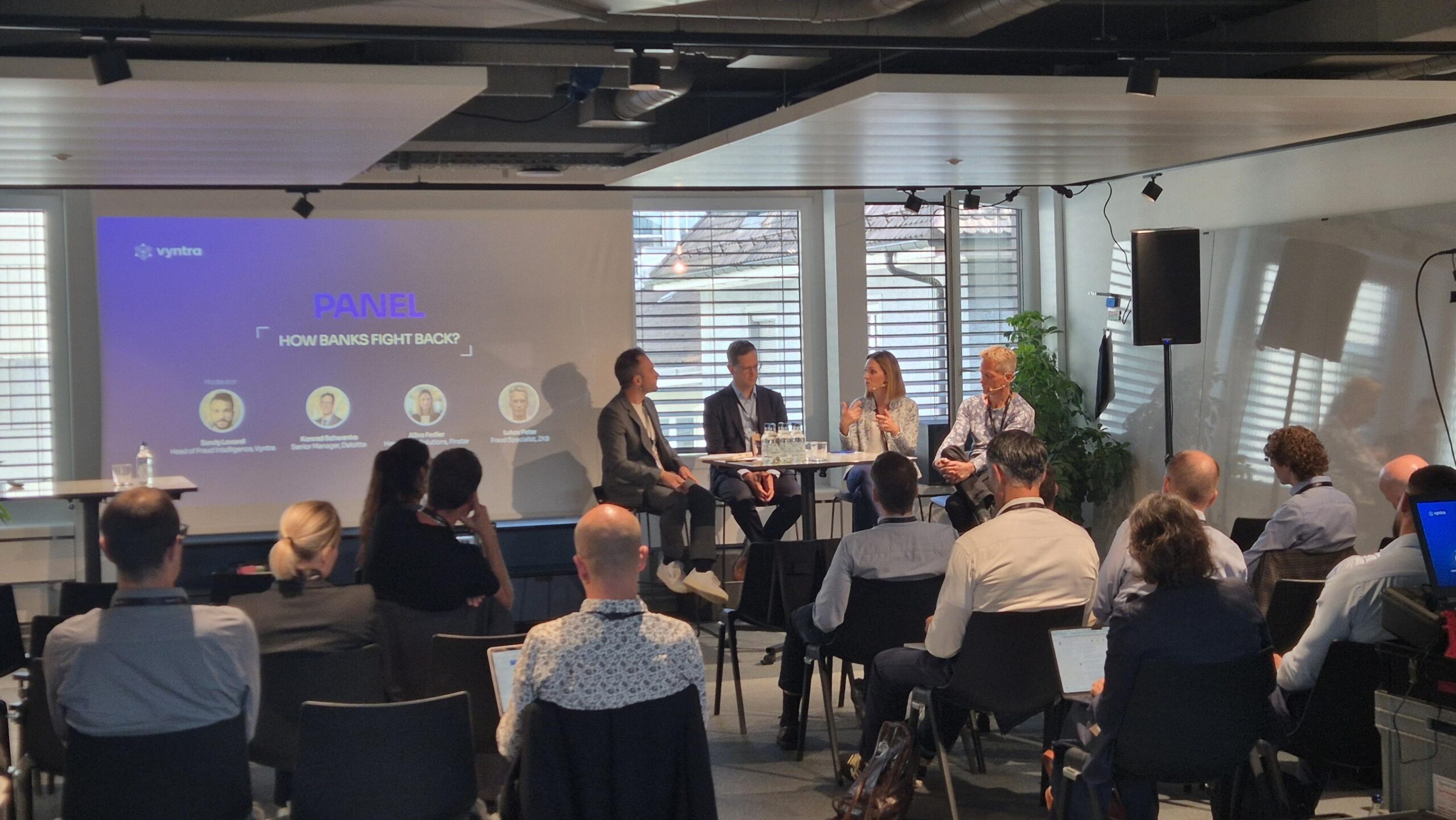



Last week, the Vyntra Club brought together banking clients, partners, and outside experts in Zurich and remotely for an afternoon dedicated to one question: how does fraud actually work today, from the psychology behind it to the reality of fighting it inside a bank?
Keynote: The psychology of deception
by Prof. Pascal Wagner-Egger, Social Psychology Researcher, University of Fribourg
Key takeaway: Naivety isn’t a personality flaw. It’s a normal cognitive process — which means anyone can fall for it.
Pascal Wagner-Egger, social psychology researcher at the University of Fribourg, opened by dismantling a comforting myth: that fraud victims are simply gullible. In reality, the cognitive biases that make us vulnerable to manipulation are the same ones that shape everyday reasoning — from believing a full moon disrupts sleep, to trusting a stranger’s personal anecdote over hard statistics (the “vividness bias”).
Two mechanisms stood out as particularly relevant to financial fraud:
- Escalation of commitment. The more money or trust someone has already invested, the harder it becomes to admit the mistake and walk away — the same psychological trap that keeps people in cults.
- System 1 vs. System 2 thinking. Drawing on Kahneman’s Thinking, Fast and Slow, Wagner-Egger argued that fraud exploits our default fast, intuitive thinking (System 1). The only real defense is deliberately activating slower, effortful reasoning (System 2) — which means fraud prevention is, in part, an education problem, not just a technology one.
Expert Talk: Scamming in 2026
by Mina Chiang, Founder & Director, Humanity Research Consultancy
Key takeaway: Large-scale fraud isn’t run by lone actors. It’s run like a business — and its workforce is often trafficked.
Mina Chiang, Founder and Director of Humanity Research Consultancy, shifted the focus from individual psychology to industrial-scale organized crime. Her research into scam compounds in Southeast Asia revealed a chilling structural insight: multiple criminal groups often co-locate in the same physical compounds, “a bit like Silicon Valley” — sharing tactics, splitting the cost of corrupting local officials, and learning from each other’s methods.
The uncomfortable truth underneath the business analogy: many of the people running the scams are themselves victims of human trafficking, coerced under guard and unable to leave.
On the response side, Chiang was clear that international enforcement — including a recent Interpol operation spanning 97 countries, roughly 6,000 arrests, and $300 million in frozen assets — is meaningful but only scratches the surface. She pointed to four concrete actions institutions can take now: educate customers before they’re targeted, improve cross-border intelligence sharing (a flagged account often stays active at other banks for days or weeks), invest in internal fraud expertise, and conduct threat research tailored to their own customer base rather than relying on generic playbooks.
Use case: What's really happening inside banks
by Konrad Schwenke, Senior Manager, Deloitte
Key takeaway: The fraud problem is bigger, faster-growing, and less “owned” internally than most institutions assume.
Konrad Schwenke, Senior Manager at Deloitte, grounded the conversation in numbers. Payment fraud losses in the European Economic Area topped €4 billion in 2024. In the US, reported scam damages hit roughly $8 billion the same year, with projections rising to $12–18 billion in the years ahead. Yet a recent FINMA survey found that only 42% of participating Swiss institutions have an actual dedicated digital fraud strategy.
Schwenke’s framing of organized fraud echoed Chiang’s: “organized crime does business development” — selecting markets, languages, and targets based on where the return on investment is highest. He flagged five converging trends: growing sophistication (specialized criminal “teams” per fraud type), the erosion of language as a barrier (deepfakes and AI now produce convincing Swiss German from operators who’ve never set foot in Switzerland), new payment rails (peer-to-peer, instant, and eventually agentic payments), unclear internal ownership of the fraud topic within banks, and mounting regulatory pressure — with the UK’s strict bank-liability regime as the most advanced (and most contested) model globally.
Panel: How banks fight back
by Sandy Lavorel (moderator), Aline Fedier, Head of Fraud Solutions, Finstar AG (formerly Julius Baer), Konrad Schwenke, and Lukas Peter, Fraud Risk Engineer, Zürcher Kantonalbank
Key takeaway: The hardest problems in fraud prevention aren’t technical. They’re about incentives, liability, and legal constraints that even well-designed detection can’t solve alone.
The panel, moderated by Sandy Lavorel, opened with a real, anonymized case: a victim coached over a single phone call into transferring EUR 285,000 across multiple payment methods to what looked like a completely legitimate Swiss bank account. The case exposed a genuine blind spot in the room: the receiving bank saw the account behave abnormally, but had little incentive to flag it, and the sending bank couldn’t legally warn the customer outright without risking a “tipping-off” offense.
The conversation surfaced real disagreement rather than a tidy consensus:
- Cross-bank visibility. Panelists pointed to an emerging Swiss initiative — a network-level risk-indicator service potentially operated by SIX — that could let participating banks see suspicious transaction patterns across institutions, not just within their own walls. Whether it becomes mandatory is still undecided.
- Who eats the loss. Lukas Peter described ZKB’s position as deliberately restrictive: customers bear the loss unless the bank was clearly negligent. Other panelists pushed back, citing reputational risk and regulatory pressure trending toward shared liability — while cautioning that the UK’s stricter reimbursement model risks distorting incentives, potentially making customers less vigilant, or even easier to exploit through fraudulent reimbursement claims themselves.
- Awareness as an unglamorous but necessary tool. One panelist admitted the session made them want to share it with their own family — a reminder that even Switzerland’s confidence in its own processes may be misplaced.
Psychology, criminology, and banking practice rarely get discussed in the same room. When they are, the conversation shifts from “is fraud a problem” to “what do we actually do about it” — and that shift, more than any single insight, is what this year’s Vyntra Club set out to create.
Vyntra talk: Vision & Innovation
by Loris Certo, Product Manager, Vyntra
Key takeaway: The industry needs a new category — Transaction Intelligence — because real-time payments have removed the safety net that made yesterday’s fraud controls sufficient.
Loris Certo, Product Manager at Vyntra, closed the day by connecting the threads the previous sessions had raised — organized, fast-moving fraud, weak cross-institution visibility, and mounting regulatory pressure — to what it demands of the technology underneath.
His starting point: payments have shifted from a batch world, where a suspicious transaction could be held and investigated, to an instant world, where transactions are no longer revocable once sent. That shift, combined with rising data volumes and the operational load of investigating large numbers of individual alerts, is why Vyntra is positioning Transaction Intelligence as a category in its own right — encompassing both transaction observability (understanding what happened to a transaction as it moves through a bank’s systems) and financial crime prevention.
Three principles anchor that vision: risk decisions need to be actionable in real time, not just detected after the fact; a single transaction carries multiple, converging risk dimensions (fraud, operational, compliance) that too often get handled in isolation; and — with the EU AI Act raising the bar on explainability — any AI used in detection needs to be able to justify its decisions.
On the roadmap, Loris outlined seven areas of focus going forward: stronger data governance built on a canonical data model, continued investment in detection and scoring, self-service rule and model authoring for business users rather than only technical teams, streamlined investigation workflows, built-in versioning and auditability, faster experimentation and retraining cycles, and a low-latency, cloud-native platform designed for zero-downtime upgrades.
His closing point echoed a thread that had run through the entire afternoon: new payment rails (instant P2P systems like Twint, Wero, and Zelle) don’t just move faster — they’ll require banks to rethink models and operating procedures built for a slower, reversible world.