


For financial institutions in the EU’s non-euro countries, the next instant-payment milestone is not simply another scheme connection. It is a test of whether they can see and manage payment flows across two live environments: domestic instant payments in local currency and instant euro credit transfers under a common regulatory framework.
Under the EU Instant Payments Regulation (IPR), credit institutions in the six remaining non-euro EU Member States – Czechia, Denmark, Hungary, Poland, Romania and Sweden – must be able to receive instant euro credit transfers by 9 January 2027 and send them by 9 July 2027. Payment and electronic-money institutions have a separate timetable: those in euro-area Member States must meet the relevant receiving and sending obligations by 9 April 2027, while those in non-euro Member States must meet their obligations by 9 July 2027.
Nine months can sound like a comfortable runway. The more useful question is not how many months remain, but what an institution can already see across its payment flows—and what it cannot.
Domestic experience is an asset, not a readiness test
The six markets are not starting from zero. Several have long-running domestic instant-payment services. But those systems operate under their own currencies, schemes, participation models and operating conditions. Their maturity is valuable experience; it is not proof that euro instant payments will behave identically.
- Poland: Express Elixir has operated since 2012, processing domestic złoty transfers around the clock. It also supports instant transfers initiated through BLIK.
- Czechia: The Czech National Bank introduced instant payments through CERTIS at the end of 2018. By 2024, participating banks handled half of interbank retail payments instantly, according to a CNB working paper.
- Hungary: The MNB’s instant-payment system launched in March 2020. The qvik payment solutions – QR, NFC, links and payment requests – are built on that system.
- Romania: TRANSFOND launched its Instant Payments service in April 2019. RoPay, a national mobile instant-payment service, followed in October 2024.
- Denmark: Instant payments have been available since November 2014. In April 2025, Danish-kroner payments became available in the Eurosystem’s TARGET Services, including TIPS for instant settlement.
- Sweden: RIX-INST, the Riksbank’s instant-payment settlement system, uses the TIPS technical platform. Since February 2024, Swish payments between accounts at different banks have been routed through RIX-INST; the system has also opened a standard settlement model to participants beyond Swish.
The detail matters: this is not one shared starting point. Some countries have extensive domestic usage, some have newer services, and the infrastructure and customer-facing schemes differ. But none of those facts, on their own, demonstrates readiness for the specific operational demands of instant euro payments.
The blind spot between rails
A mature domestic rail can create a misleading sense of familiarity. The institution knows how its local-currency payments move, how the domestic scheme behaves and which teams respond when something goes wrong. The euro rail introduces another operating environment with its own connectivity, liquidity, scheme rules, processing windows, monitoring needs and failure modes.
The problem is not that the two rails are necessarily incompatible. It is that operating them in parallel can make it harder to answer a basic question across the whole institution:
Are payments moving through the process as expected, on every rail, right now?
Infrastructure monitoring dashboards answer whether servers, networks and applications appear healthy. They may not show whether a payment has stalled at a hand-off, whether a queue is growing or whether a step’s latency is threatening the end-to-end time window.
That distinction is particularly important for instant payments. The IPR defines an instant credit transfer as one executed immediately, 24 hours a day and on any calendar day; its requirements include crediting the payee’s account within seconds. In a time-constrained flow, operational visibility needs to follow the payment itself, not stop at the health of the systems carrying it.
Vyntra’s existing writing describes this as the difference between system observability and business-layer visibility: a dashboard can be green while a payment sits in a queue or fails to progress to its next expected step.
Compliance is not the same as control
Meeting the regulatory deadline is essential. It is not, by itself, proof that an institution has operational control over the payment journey.
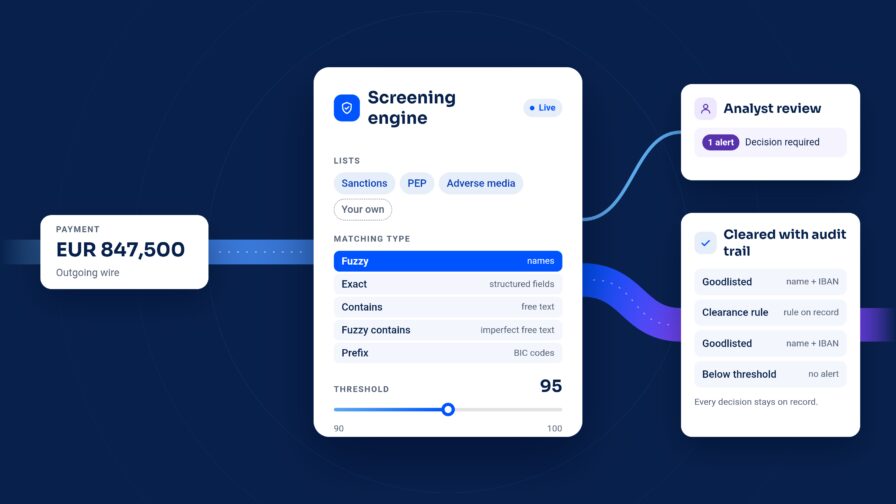
The IPR introduces a specific sanctions-screening process for instant credit transfers: payment service providers must periodically verify, and do so at least daily, whether their payment service users are subject to targeted financial restrictive measures. The regulation was designed in part to address the operational challenges caused by screening payer and payee names in every instant-transfer transaction.
That is a specific obligation, not a replacement for an institution’s wider sanctions, AML or fraud controls. Nor does it answer all the operational questions around a payment: whether it was screened at the relevant stage, whether the applicable control completed, what happened next, and whether the payment settled, was rejected or timed out.
For that, institutions need to connect control outcomes with transaction context and flow status. A screening result without a traceable payment journey can leave operations and compliance teams looking at separate pieces of the same event.
What readiness looks like
Readiness should be measured not only by whether an institution can send and receive instant euro payments, but also by whether it can identify and act on problems before the customer is the first to notice.
That means being able to:
- Track a payment from initiation to settlement across connected systems and rails.
- See queue depth, processing time and state changes at critical hand-offs.
- Detect stalled or delayed transactions before a processing window closes.
- Identify which step or dependency is causing the delay.
- Understand which payments and values may be affected.
- Reconstruct an auditable timeline of what happened and what action followed.
- Connect payment status with relevant screening, validation and fraud-control outcomes.
This is consistent with Vyntra’s published approach to Transaction Observability: centralise transaction data across rails and formats, follow the payment lifecycle and use real-time alerts to detect bottlenecks before they become customer-facing incidents.
The same visibility is valuable beyond the 2027 deadline. Domestic instant payments do not become less operationally important because they are already established. A dual-rail environment is an opportunity to improve visibility across both flows, rather than treating the new euro rail as a separate compliance project.
The advantage is what institutions can see
Non-eurozone institutions have two useful starting assets: experience operating domestic instant payments and visibility into the implementation challenges faced by earlier adopters. But those assets create an advantage only if they are translated into practical readiness.
The 2027 milestones are a forcing function. They ask institutions to support instant euro payments, but also invite a wider operational question: can teams see what happens to payments across currencies, rails, systems and control points and act while there is still time to intervene?
The real test is not just whether the institution can connect to another rail. It is whether anyone can see, in real time, when a payment stops moving.
FAQ
Which countries are affected by the 2027 deadlines?
The non-euro EU Member States are Czechia, Denmark, Hungary, Poland, Romania and Sweden. Credit institutions in those countries must receive instant euro credit transfers by 9 January 2027 and send them by 9 July 2027. Payment and electronic-money institutions in non-euro Member States have a 9 July 2027 deadline for the relevant obligations.
Does a domestic instant-payment system mean an institution is ready?
What does the IPR require on sanctions screening?
What is the operational question institutions should ask?
Institutions should verify if teams can see whether each payment is progressing across its lifecycle, where it is delayed, which control or system is involved, and what may be affected, before a timeout, rejection or customer query exposes the problem.
Missed us at Sibos Miami?
Book a demo and we’ll show you exactly how Vyntra works for your institution.