

Vyntra had the pleasure of being at Sibos in Miami for four days of talks and conversations with payment professionals from across the industry. The payments space is hot. More than once we heard speakers say that more has changed over the past year than in the years before, and after four days on the floor and in the sessions, it is hard to disagree.
ISO 20022 reality check: What banks told us at Sibos 2026
At Sibos 2026, one theme dominated our booth conversations: ISO 20022 is no longer a migration project, it’s a data program. Banks that treated it as “message conversion only” are now wrestling with address quality, exception and investigation handling, and end‑to‑end visibility. Those that started from the data side are already seeing gains in straight‑through processing (STP), sanctions screening, and customer reporting.
Below are the patterns we heard most often and how they map to the journey we’ve been describing since 2023, when we wrote that ISO 20022 is the most impactful event in payments in decades and warned that minimal compliance would mean missed opportunities.
1. “We’re message ready, but not data ready”
Multiple teams said they can send/receive MX, yet a large share of their cross‑border flow still carries unstructured debtor/creditor addresses. That’s exactly why SWIFT postponed the removal of unstructured addresses (originally planned for the SR2026 release in November 2026) and why current snapshots still show ~60%+ of payments with unstructured addresses.
What it means in practice:
- Payments risk delay or rejection once the new deadline hits.
- Screening and reconciliation stay noisy because key fields (structured names, addresses, purpose codes) aren’t consistently populated.
Our take: Treat address structuring as a data governance initiative with owners in operations, compliance, and client onboarding, not just a payments IT ticket.
2. Coexistence didn’t end the complexity: it changed its shape
Even after MT/MX coexistence ended in November 2025, banks still operate in a hybrid environment, with domestic rails, legacy corridors and counterparties at different stages of adoption. Many banks continue to use MX primarily for communication with the outside world, while internal systems and processes may still rely on legacy formats or translated data.
As a result, the challenge is no longer simply receiving and parsing MX messages. It is preserving the richer data, correlating messages across formats and systems, and making that information usable for operations, compliance and customer service.
What we heard:
- The pain point shifted from “can we parse MX?” to “can we preserve, correlate, and act on the richer data across MT, MX, and domestic formats?”
- Teams want a single source of truth for 10+ years of history to answer regulator requests, client queries, and internal investigations without stitching together silos.
Our take: This is the core of transaction observability: index every message (MT/ISO 20022/domestic), keep an auditable trail, and make it searchable in seconds.
3. The US is “live”, but the work is just starting
With Fedwire migrated in March 2025, CHIPS migrated in April 2024, and RTP/FedNow ISO 20022‑native, US participants are largely past basic cutover. The conversations at our booth reflected that: fewer “how do we migrate?” questions, more “how do we reduce exceptions and enrich data end‑to‑end?”
Patterns we saw:
- Exception and investigation management dashboards tied to specific fields (e.g., missing structured address, invalid code).
- Reconciliation teams asking for cohort analysis (by corridor, counterparty, product) to target remediation where it moves the needle.
Our take: Once the rail is ISO 20022, the competitive edge comes from data quality + analytics, not just connectivity.
4. Corporates are the next bottleneck (and opportunity)
Several transaction banks raised the MT 101 coexistence end in November 2026: corporates can still initiate via MT 101 but must use structured address options (e.g., field 59F) or move to pain.001. The risk is a surge of truncated or rejected payments if initiators aren’t prepared.
What helps:
- Clear guidance to corporates on which fields to populate and why (fewer queries, faster reconciliation, better cash forecasting).
- Incentives linked to tangible outcomes (e.g., reduced investigation time, improved SLA).
Our take: Make the corporate case in their language: operational relief and better treasury insights; not just compliance.
5. The real value shows up in operations, compliance, and CX
This echoes what we wrote in 2023 and reinforced at EBAday 2026: the challenge is no longer simply adopting ISO 20022. It is achieving consistent, high-quality data across payment systems, formats and corridors. Adoption is progressing at different speeds across regions, and implementation maturity varies between institutions and market infrastructures.
The institutions making the most progress are using ISO 20022 data to:
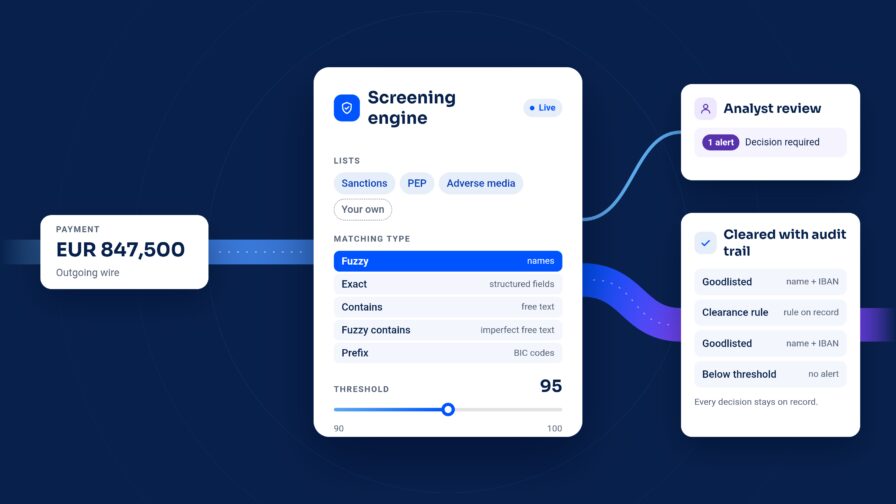
- Improve sanctions and AML screening through better-structured names, addresses and purpose information.
- Increase straight-through processing and reduce manual repairs by enforcing validation rules and code lists.
- Provide better client reporting and portals powered by enriched, searchable transaction data.
Our take: If you can’t observe the journey, you can’t optimise it.
A pragmatic playbook (from booth conversations)
If you’re looking for a next‑90‑days plan, this is what resonated most:
- Measure your baseline: % of payments with structured debtor/creditor addresses; exception/rejection rates by corridor and counterparty.
- Cleanse and enforce: Normalize addresses, validate code lists, and impose structured fields for high‑risk corridors.
- Unify the view: Index MT, ISO 20022, and domestic messages into a single, auditable repository with fast search and exports.
- Operationalise: Turn enriched fields into rules for fraud, reconciliation, and client communications, i.e., make ISO 20022 data actionable.
How this connects to our earlier ISO 20022 posts
- In “ISO 20022 finally becomes reality – what now?” we warned that most banks focused on infrastructure for dual‑format processing but still had a long way to go to fully utilise the new standard’s capabilities, including archiving and analytics.
- In “Payment technologies are evolving fast but it’s the payments data that makes the difference” we argued that granular payment data is the ingredient for both compliance and competitive differentiation and that investing in data technologies is the safest, most impactful decision.
- At EBAday 2026, we highlighted that the real opportunity lies in what banks build on top of ISO 20022: fraud detection, faster reconciliation, smoother cross‑border; via transaction observability.
Sibos 2026 confirmed that thesis: the banks pulling ahead are those treating ISO 20022 as a data and operations programme, not a one‑off migration.
If you’d like to continue the conversation we started at the booth, we can walk through your current exception profile and show how a unified, searchable data layer turns ISO 20022 richness into measurable STP, screening, and client‑experience gains.
Missed us at Sibos Miami?
Book a demo and we’ll show you exactly how Vyntra works for your institution.