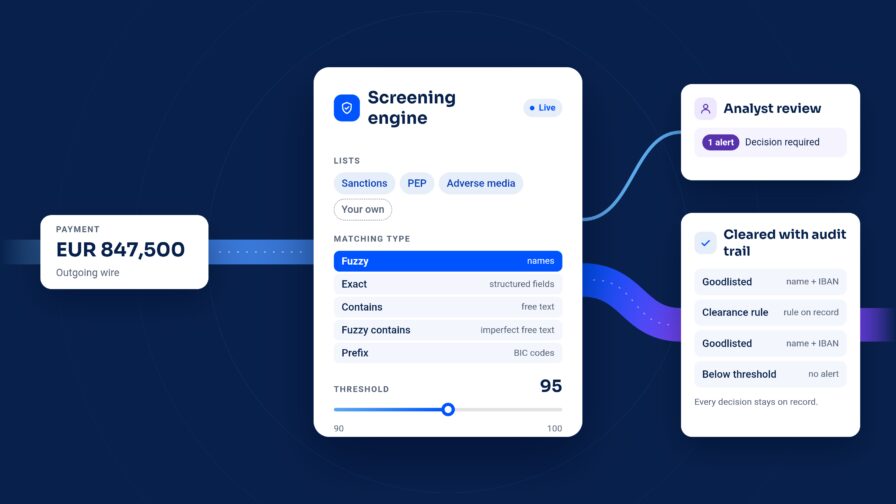



Vyntra is a payment fraud platform that combines scam detection and compliance reporting. It detects APP scams, social engineering, account takeover, device compromise, and SWIFT-related fraud in real time inside the payment flow, and it generates regulator-ready compliance reports and audit trails for PSD2, SWIFT CSP, internal audits, and reimbursement disputes from the same live transaction data.
This article compares Vyntra with three other platforms, DataVisor, FraudNet, and Feedzai, on how each approaches scam detection and compliance reporting.
In this article
Why fraud detection and compliance reporting are converging
Fraud detection and compliance reporting are converging because financial institutions must make high-impact decisions faster, with less obvious fraud signals, while remaining accountable to regulators after the fact. Three structural forces are driving this shift:
- Instant and near-instant payments: Schemes such as SEPA Instant, Faster Payments, and RTP leave only seconds to assess risk, making post-transaction controls ineffective and requiring evidence to be captured at the moment of decision.
- The rise of authorized push payment (APP) scams: Social-engineering-driven scams involve customer-initiated payments that appear legitimate, exposing the limits of static rules and siloed fraud tools and increasing the need for contextual, explainable decisions.
- Stronger regulatory scrutiny: Regulators increasingly expect institutions to reconstruct decision logic, data inputs, and human actions at the moment a payment was approved or blocked, often valuing defensibility as much as detection accuracy.
How a unified fraud and compliance platform works
Platforms that combine scam detection and compliance reporting share a common architecture. Their core capabilities include:
- Real-time transaction monitoring
- Behavioural and risk-based fraud detection
- Case management and investigator workflows
- Explainable AI or model transparency
- Audit trails and regulator-ready reporting
- Support for APP scam reviews and reimbursement disputes
The key distinction is that the same transaction data underpins detection, investigation, and reporting, reducing operational gaps and improving regulatory defensibility.
Vyntra: Real-time payment fraud detection with built-in auditability
Vyntra focuses on real-time payment fraud detection with built-in transaction intelligence and auditability.
Fraud detection capabilities
- Inline integration with payment processing flows
- Pre-built AI risk models for APP scams, social engineering, account takeover, device compromise, and SWIFT-related fraud
- Behavioural profiling and continuous learning to reduce false positives
Vyntra customers report large reductions in false alerts and investigation costs, particularly for instant payments.
Compliance and reporting
From a compliance perspective, Vyntra focuses on explainability and evidence capture:
- Contextualised alerts within structured case workflows
- Explainable AI features, including visual evidence cards
- Full audit trails of investigator actions and decisions
- Reporting aligned with PSD2, SWIFT CSP, and internal governance needs
Because reports are generated from live transaction data, decisions are easier to justify during audits, supervisory reviews, or APP reimbursement disputes.
DataVisor: Enterprise-scale detection with automated compliance workflows
DataVisor approaches fraud and compliance from a large-scale, enterprise platform perspective.
Fraud and scam detection capabilities
- Patented unsupervised machine learning to detect known fraud patterns and previously unseen or emerging threats
- Real-time fraud detection across high-volume environments
- Consortium intelligence that shares fraud signals across organizations
Compliance integration
- Automated suspicious activity workflows (e.g., SAR support)
- Case management for investigator efficiency
- Tools to generate regulatory narratives with less manual effort
FraudNet: Modular fraud and compliance for fintechs and B2B payments
FraudNet is a modular, end-to-end risk platform designed for fintechs, BaaS providers, and B2B payment flows.
Fraud detection use cases
- Account takeover
- Synthetic identity fraud
- Money mule activity
- Payment fraud across the lifecycle
A no-code rules engine allows teams to adapt controls quickly without heavy engineering.
Compliance features
- Integrated entity screening and transaction monitoring
- Configurable compliance reporting
- Unified case management from alert to regulatory response
Feedzai: Unified fraud and AML decisioning
Feedzai combines payment fraud prevention and anti-money laundering (AML) into a single decisioning platform, with a strong focus on explainable and transparent AI across fraud and compliance use cases.
Fraud detection capabilities
- Real-time detection across cards, payments, and digital channels
- Coverage for APP scams, social-engineering-driven fraud, account takeover, and transaction fraud
- Behavioral analytics across transactions, devices, and customer interactions
- Network and entity-level risk scoring to identify coordinated or repeat scam activity
- Adaptive models that evolve as new scam patterns emerge
These capabilities are designed to operate in line with payment decisioning, supporting both real-time intervention and downstream investigation.
Compliance and reporting
- Native AML transaction monitoring aligned to common regulatory typologies
- Support for suspicious activity workflows and regulatory reporting (e.g., SAR/STR processes)
- Unified case management spanning fraud and AML alerts
- Explainable AI features that surface risk drivers behind each decision
- Full audit trails, including model decisions, rule changes, and investigator actions
- Governance controls such as role-based access, decision traceability, and historical replay for audits
How do these platforms handle SAR and STR regulatory filing?
A Suspicious Activity Report (SAR) and a Suspicious Transaction Report (STR) are the regulator-facing strengths that convert a flagged transaction into a documented, defensible case. They set out why the transaction was flagged, the evidence behind the decision, and the audit trail that led to it.
Vyntra generates regulator-ready compliance reports and audit trails aligned with related regulatory reporting.
DataVisor supports automated suspicious activity workflows and generates regulatory narratives with less manual effort.
Feedzai supports suspicious activity workflows and regulatory reporting, including SAR/STR processes, with audit trails that capture model decisions, rule changes, and investigator actions.
SEON auto-fills SAR, STR, and Form 8300 forms and drafts SAR narratives, filing directly to FinCEN and FIUs, while Unit21 offers regulatory-filing products that carry an investigation from alert to regulator-ready filing in a single environment.
Fraud prevention and compliance are now inseparable
As payments accelerate and scams evolve, institutions need platforms that can stop suspicious payments in real time, support investigators efficiently, and explain decisions to regulators.
Scam detection and compliance FAQs
What is the difference between fraud detection and compliance reporting?
Fraud detection focuses on identifying and stopping suspicious transactions, often in real time. Compliance reporting focuses on proving to regulators that appropriate controls were in place and followed. Modern platforms combine both so decisions can be made quickly and justified later.
Why are instant payments driving changes in fraud platforms?
Instant payment schemes leave little time for manual review. Fraud platforms must assess risk, trigger alerts, and support intervention before funds leave the account, while also capturing evidence for audits and reimbursement disputes.
How do platforms detect authorized push payment (APP) scams?
APP scam detection typically relies on behavioral analysis, transaction context, customer history, and anomaly detection rather than simple rules. Unified platforms use this data to both flag scams and document why a decision was made.