

As a bank researching how to spot and solve payment anomalies, discovering a problem after an SLA breach causes so many problems and strain on resources that you know it’s time to have a better solution.
The challenge is knowing which capabilities will actually help you detect, investigate, and respond to these issues earlier.
Looking for a payment anomaly detection solution built for banks? Book a demo with Vyntra today.
In this article
Why traditional payment tools aren’t enough for banks (and what to look for instead)
As we’ve covered, effective payment anomaly detection requires visibility into how payments normally behave, where they deviate, and what is affected. Traditional payment monitoring tools often fall short of providing that full picture. Here’s where the main gaps lie and what to look for instead.
They monitor individual systems rather than the full payment journey
A single payment usually moves through multiple channels, rails, and internal systems before settlement. Each step can produce its own events and transaction data, including timestamps, amounts, beneficiary details, and processing statuses. Most monitoring tools only watch one of those stages at a time.
As a result, there may be no single end-to-end view of the payment. When something goes wrong, teams have to reconstruct the payment’s path across systems and formats to work out where it went and what happened at each stage. This slows investigation and resolution and makes it harder to produce a clear record for compliance and audit.
Ideally, you want a single solution that correlates events across systems and payment formats into a single end-to-end transaction lifecycle. That gives operations, compliance, and audit teams one place to trace what happened instead of manually reconciling several systems.
They track system health rather than payment behaviour
Traditional IT monitoring focuses on infrastructure health, such as CPU, disk space, and whether applications and processes are running. None of that necessarily tells you about payment performance or whether payments are moving normally. A payment can spend longer than expected at one stage, start building up in a queue, or skip processing steps while every IT dashboard still shows green.
Instead, you want a monitoring tool that establishes normal patterns across payment volume, value, timing, and flow, then compares live activity against those baselines. It should identify unexpected paths, missing steps, processing delays, and changes to important transaction fields such as amounts, accounts, or beneficiaries. That way, teams can spot payment problems that infrastructure monitoring alone may not reveal.
They detect problems after the impact has already been made
Traditional monitoring is often reactive. Teams may only become aware of a problem after a system fails, an SLA is breached, or a customer asks where their payment is. By then, customer relationships and the bank’s reputation are already at risk. Teams are left managing the consequences of an existing incident rather than getting ahead of it.
A solution designed specifically to detect payment anomalies will have internal and regulatory SLA monitoring, and alerts when payment flows approach or exceed expected thresholds. Teams should also have immediate access to the underlying transaction data. Together, these capabilities help identify developing payment issues, investigate the cause, and respond before the impact spreads further.
They lack the payment context needed to understand the impact
Even when traditional monitoring detects a technical issue, it may not show what that issue means for the bank. Teams still need to know how many transactions are affected, how much value is involved, and which customers or payment flows are exposed. Without that context, it is harder to distinguish a relatively small exception from a higher-value issue requiring immediate attention
Choose a payment anomaly detection tool that connects an issue to the affected transactions and immediately shows the associated volume and value at risk. Teams should also be able to drill into the supporting payment data to understand where the issue occurred. That way, they can assess the scale of the problem, prioritise the highest-risk issues, and decide how to respond.
If your existing tools leave these gaps, building the missing capability in-house can seem like the next best option. Some banks take this route, but it means solving three difficult problems at once:
- Collecting transaction data without slowing live processing.
- Interpreting and maintaining domestic and international payment formats as standards evolve.
- Correlating events across systems when no single identifier follows a payment from start to finish.
Each of these requires specialist knowledge and ongoing maintenance, adding time and unsustainable costs to the build. This is where working with an established payment anomaly detection provider can help.
What a dedicated payment anomaly solution can do
In payments, anomaly detection answers questions like: Is something happening outside the normal pattern of how payments enter, move through, or leave your bank? Or is a customer’s payment behaviour changing in a way that could indicate fraud?
In practice, a dedicated payment anomaly detection should:
Flag changes that fall outside normal payment patterns
Anomaly detection learns the typical payment patterns across three key dimensions:
- Volume: How many transactions would you normally expect?
- Value: What value of transactions would you normally expect?
- Payment flow and timing: How should transactions normally move through the bank, and how long should that journey take?
It then builds a baseline of what normal activity looks like and flags deviations from those expected patterns. For example:
- A corporate client that normally sends 10 transactions a day and 10,000 at month-end suddenly sends 100,000 on a Wednesday afternoon in the middle of the month.
- A customer whose daily payments normally stay within a predictable value range suddenly sends payments worth far more than usual.
- A payment that normally takes three seconds to pass through five systems suddenly spends 20 seconds between two stages.
These deviations tell the bank that something has moved outside the expected pattern, but not necessarily what is wrong or how serious it is. To investigate and decide how to respond, your teams need context.
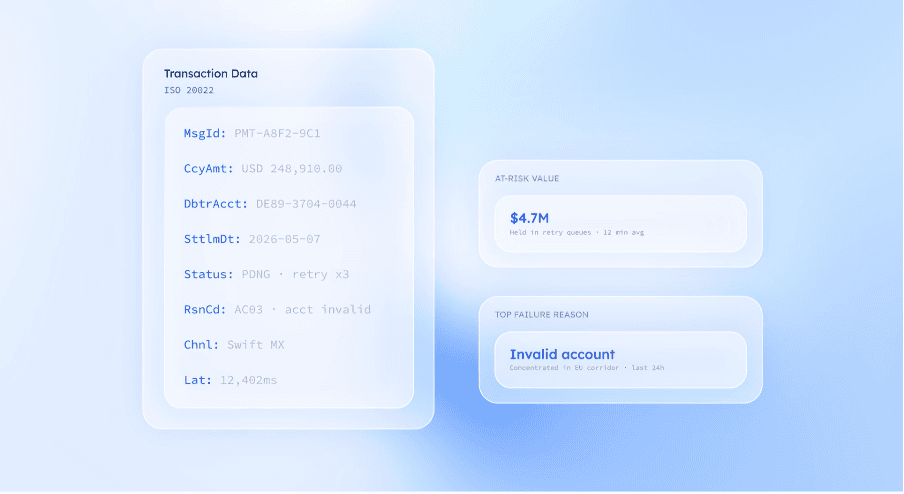
Show volume and value at risk so teams can respond
Effective anomaly detection does more than tell you something unusual is happening.
It shows where the anomaly occurred, which transactions are affected, and the volume and value at risk.
This context matters because an alert alone does not give teams the full picture or how urgently they need to respond. One unusual transaction worth €50 calls for a very different response than 10,000 affected transactions worth €10 million.
Seeing the number and value of payments affected helps teams understand what is at stake, prioritise the issue, and plan the appropriate response.
Identify when expected payment activity does not happen
Anomaly detection is not limited to unusual activity that appears within your own bank. Your own systems may be working normally even though a problem is developing elsewhere within your payments ecosystem.
For example, suppose you normally receive a predictable volume and value of payments from a correspondent by 10 a.m. each day. If 10 a.m. arrives and that expected flow has not appeared, the absence itself becomes an anomaly.
Spotting that change early gives you time to determine whether the problem sits with the correspondent. And if it does, contact them, assess which payment flows could be affected, and prepare contingencies before the disruption spreads downstream.
Ultimately, payment anomaly detection is about giving teams visibility while an issue is developing, rather than after an outright failure. You can see what changed, locate where it happened, understand the volume and value at risk, and decide what needs attention first.
Detect payment behaviour that could indicate fraud
Anomaly detection can also look beyond the health of your payment flows to spot activity that may indicate payment fraud. By comparing customer activity with established behaviour, it can spot irregularities like:
- A customer suddenly sends a much larger payment.
- Several payments are made to new beneficiaries within a short period.
- Payment frequency, timing, or destination changes sharply.
This is particularly useful for types of fraud that can be difficult to detect through technical payment security controls alone, such as authorised push payment (APP) fraud. With APP fraud, social engineering is used to manipulate a customer into making and approving the payment themselves.
The transaction may therefore come from the right customer, device, and account using valid credentials, even though the customer has been deceived. However, if the value, beneficiary, timing, or frequency looks unusual, anomaly detection can flag the transaction as suspicious so teams can review or stop it before the funds are transferred.
How Vyntra helps banks detect and respond to payment anomalies
Vyntra is a global transaction intelligence platform that brings together transaction observability and financial crime prevention. Our Transaction Observability Platform provides real-time visibility across the payment lifecycle, helping banks understand what happened, where it happened, which payments are affected, and how much value is at risk.
Top banks around the world, including Bank of Africa, UOB, and Standard Bank, use Vyntra to detect payment anomalies, find transactions quickly, and manage reputational exposure. Here’s how you’ll benefit from choosing us for payment anomaly detection:
Detect anomalies earlier and immediately understand the volume and value at risk
Banks may know their systems are running without knowing whether payments are moving as expected. Payments can slow down, pile up, or follow unusual paths while infrastructure dashboards remain green.
With Vyntra, you can identify and address payment anomalies earlier. Our Transaction Observability solution learns what normal activity looks like, from typical volumes to how transactions move through the bank. It then delivers real-time alerts for missing steps, unexpected data changes, or processing delays against internal and regulatory SLAs. This way, your teams can pinpoint developing issues and respond before they become payment failures.
Even when teams catch a payment issue early, it’s crucial that they understand its scale. An issue affecting a handful of low-value payments may require a very different response from one affecting thousands of transactions worth millions.
Vyntra connects anomalies to the affected transactions, showing the volume and value at risk. Teams can drill into the customers, payment flows, and transaction history involved to see what is affected and decide what to prioritise.
See beyond your own data to catch psychological scams and multi-rail fraud
Without visibility across multiple payment rails, or what other banks have flagged as high risk, detection stays limited. Vyntra helps you catch multi-rail fraud and scams beyond what your own data can see.
Our solution provides a 360-degree customer view across rails, built from your own data plus external signals like credit card fraud and community scoring intelligence, shared anonymously across Vyntra’s consortium of banks. These all feed into one risk assessment view, extending detection beyond your own data. This helps you track suspicious activity as it moves from credit cards to credit transfers and payment apps or between banks.
For example, when another institution flags an account as a suspected mule, payments heading there receive a higher risk score, even if you’ve never encountered the account.
Session and transactional behaviour analysis also teaches your systems what normal activity looks like for each customer, so they can flag an account takeover the moment behaviour changes. Together with the 360-degree risk view, this helps you catch fraud earlier and stop payments before money leaves the account.
Find a “lost” payment quickly thanks to a unified view of payments across existing systems and controls
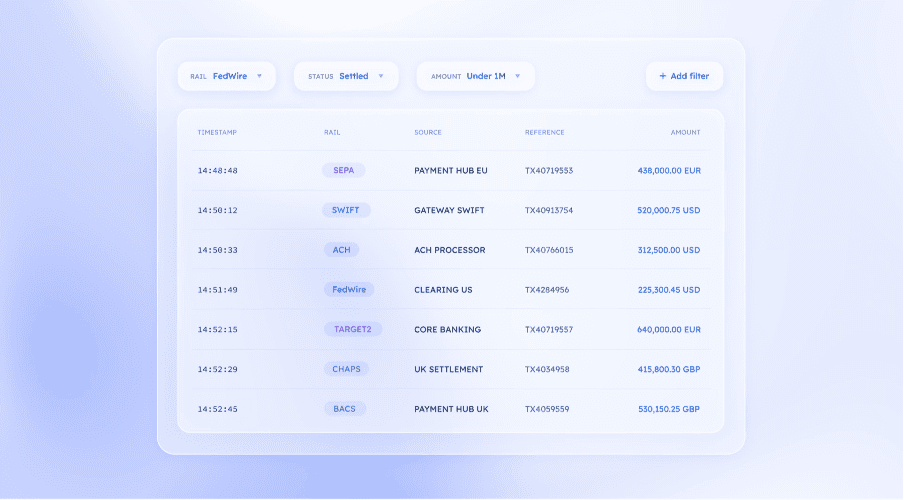
Payment visibility is often fragmented across systems. A single payment can generate separate events as it moves through different platforms and formats, making the complete journey difficult to reconstruct. Vyntra gives you a single end-to-end view of the payment lifecycle.

Our solution correlates payment events into one transaction lifecycle. That way, teams can see where each payment went, what happened at each stage, and where an issue occurred.
It also makes the underlying financial transactions and supporting records searchable in one place. Investigators can trace the issue and respond faster without piecing together information across separate systems and logs.
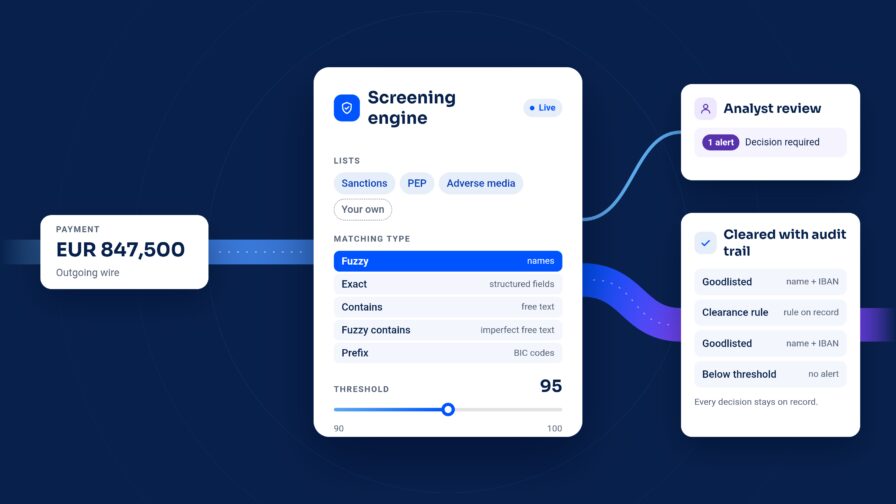
Compliance controls can often create another layer of fragmentation. AML, sanctions screening, and fraud checks run in separate systems, making it difficult to confirm which checks a payment passed. We also bring those results into the transaction lifecycle to identify missing or bypassed control steps. That gives your operations and compliance teams a clearer audit trail of which controls were completed and where further investigation is needed.
Get payment anomaly detection without overhauling your existing infrastructure
Putting effective payment anomaly detection in place can be challenging. It requires connecting multiple platforms, interpreting changing payment formats, and correlating separate events into complete payment journeys while keeping your operations running as normal. Vyntra makes the whole process easier.
Our solution sits as a layer on top of your infrastructure, bringing together transaction data from across your payment environment without changing your underlying systems. It then combines established transaction-correlation logic with a continuously updated library of global payment standards, including SEPA, SWIFT, and BACS.
This means you can:
- Reconstruct payment journeys across formats.
- Access both standardised transaction views and original records for investigation, validation, and audit.
- Avoid the burden of maintaining format definitions internally.
Because much of the technical groundwork is already built in, you can start detecting and addressing payment anomalies sooner without disrupting the payment processes your bank already relies on.
How a Tier 1 global bank improved payment anomaly detection with end-to-end visibility
A Tier 1 global bank was struggling with fragmented visibility across its payment operations. The bank had no single view of payments from end to end, relied on IT-led monitoring without business context, and spent significant time on manual reporting.
As a result, incidents had to be investigated across multiple systems and teams, delaying resolution. Issues were also identified too late, frustrating customers and increasing operational and regulatory risk.
With Vyntra’s Transaction Observability Solution, the bank got a single, real-time view of its payment flows, helping teams detect issues faster, understand their impact more clearly, and move from reactive to proactive operations.
The bank achieved:
- 95% faster response rates for complex investigations.
- 90% faster customer responses.
- 50% fewer “where is my payment?” calls.
The case shows how end-to-end payment visibility can help banks detect anomalies earlier, resolve issues faster, and reduce the impact on customers and operations.
Use payment anomaly detection to move from reactive to proactive monitoring
Payment anomaly detection helps you see when payment activity starts moving outside normal patterns. An effective solution goes beyond detection. It provides end-to-end visibility, alerts you as issues develop, and gives you the transaction context needed to understand what is affected and how urgently to respond.
Delivering that level of visibility requires specialist knowledge across payment data, formats, transaction correlation, and real-time monitoring. These capabilities also need to work across complex banking environments without disrupting live payment processing.
An experienced provider like Vyntra gives you a purpose-built platform that brings all of this together, with ongoing updates and support as payment systems, formats, and requirements evolve. That way, you can detect problems earlier, investigate them faster, and make more informed decisions about how you manage and improve your payments.
Want to see every payment from initiation to settlement and act before anomalies become incidents? Book a demo with Vyntra
FAQs
What types of payment anomalies can banks detect?
The types of payment anomalies banks can detect include changes in payment volume, value, flow, timing, and customer behaviour, such as transaction spikes, unusually large payments, processing delays, missing expected flows, or activity that may indicate fraudulent payments.
How is payment anomaly detection different from traditional payment monitoring?
Payment anomaly detection is different from traditional payment monitoring because it looks beyond technical signals, infrastructure performance, and predefined rules. It learns normal patterns across payment flows and customer behaviour, then flags deviations that fixed thresholds or system alerts may miss.
Why is end-to-end payment visibility important for anomaly detection?
End-to-end payment visibility is important for anomaly detection because it shows how a payment moves across systems from initiation to settlement. This helps teams see where an anomaly occurred, what happened before and after it, and which transactions may be affected.