


Sanctions screening is no longer a back-office compliance task. It is a real-time control embedded across onboarding, payments, counterparty due diligence and ongoing risk management—whether your institution operates in Switzerland, Luxembourg, the wider EEA or across borders.
As sanctions regimes evolve and transaction volumes grow, financial institutions need screening that does more than generate alerts. They need a solution that reduces repetitive false positives, preserves auditability and lets compliance teams focus on genuine financial crime risk.
Looking for a payment sanctions screening solution built for your bank? Book a demo with Vyntra today.
In this article
The screening challenge
Institutions must screen customers, counterparties, payments and free-text fields against sanctions, PEP and adverse media lists. The challenge is not simply matching names: it is making accurate, explainable and timely decisions at scale.
Sanctioned parties rarely appear under the exact name on a list. They use aliases, alternative spellings, transliterations and variants that can surface in free-text payment references as often as in structured customer records. Static matching responds with volume: every near match becomes an alert, the same false positive returns week after week, and analysts spend their day closing alerts they have already cleared.
The real cost is the genuine hit that gets lost in the noise. A screening programme that produces more alerts than a team can meaningfully investigate does not improve risk management; it shifts the burden to analysts and increases the risk that material threats are missed.
Why legacy screening fails
A better operating model
Effective sanctions screening should not simply create more alerts. It should help compliance teams make better decisions faster, with full visibility into why each decision was made.
Vyntra Screening is built around a simple principle: reduce repetitive noise, retain control, make every decision auditable. It combines trusted data, configurable matching, false-positive controls, selective re-screening and transparent calibration.
Built on trusted data
Vyntra Screening uses Dow Jones Risk & Compliance data, covering sanctions and official lists, exclusion lists, politically exposed persons and their relatives and close associates, and adverse media on individuals. Adverse media on companies is available as an add-on.
Screening is not limited to a primary name. The engine screens the variants held on each profile, including:
- Primary names
- Also-known-as and formerly-known-as names
- Spelling and language variations
- Transliterated variants
- Low-quality and reclassified aliases
- Bank identifier codes
This matters because a known name variant can be caught through exact-quality matching rather than being left entirely to fuzzy logic. Lists are updated at least three times a day, with a full rebuild every two weeks, so screening runs against the latest ingested version.
Matching that reflects reality
Real-world names are imperfect. Customers enter incomplete details, payment messages contain free text, transliteration conventions differ, and sanctioned entities appear under multiple aliases.
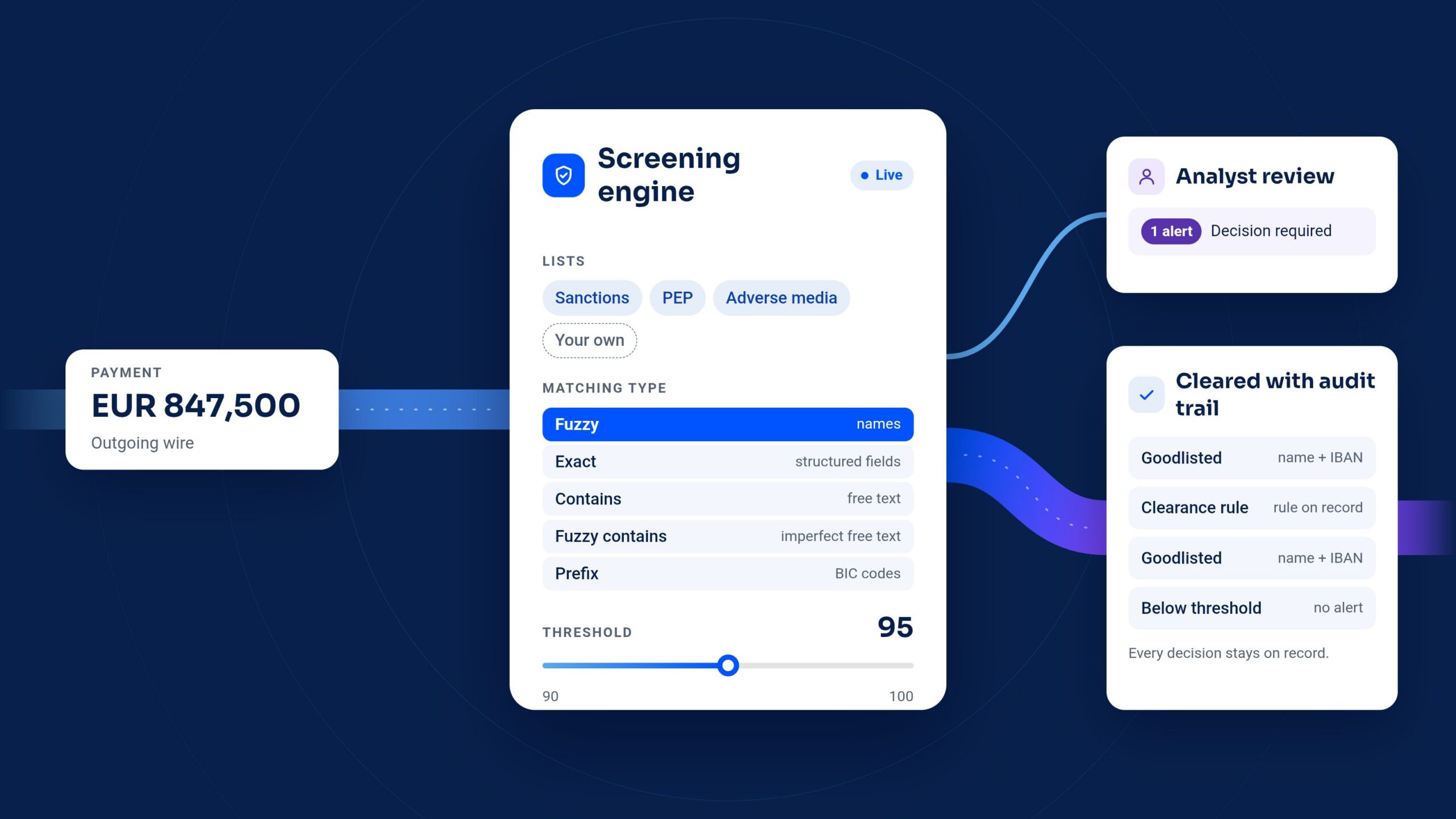
Vyntra supports five matching types, configured per screening flow:
Each screening flow defines what is screened, against which lists and with which matching type. Institutions can apply different logic to customer onboarding, payment screening, counterparty checks and internal watchlists.
The matching process is deliberately explainable. Names are normalised and Cyrillic can be transliterated on request. Candidates are retrieved using edit distance and phonetic similarity, then scored with Jaro-Winkler. Compliance teams can inspect scores in a test environment and calibrate thresholds to their own risk appetite and data quality.
Reducing false positives safely
False positives consume analyst time, delay payments and obscure genuine risk. Vyntra addresses them through controls that are designed to be safe, configurable and auditable.
Goodlisting: Close a false positive once on up to three parameters you choose, such as name plus IBAN. That combination is filtered next time, while the same name on a different account still alerts.
Retroactive goodlisting: Closing the first alert in a repeated pattern can close every other open alert with the same keys and match in one action.
Clearance rules: Known false-positive patterns close automatically, using a library of 50+ ready-made rules or your own. Every closed alert remains on record with the rule that closed it.
Impact analysis before go-live: Test a draft rule against historical alerts. The report shows how many alerts it would have cleared, provides examples and flags any that were true positives.
Selective re-screening: Customers are re-screened automatically, but an alert is raised again only when the list record or the customer’s own data changes materially.
Custom lists: Institutions can bring internal blacklists, risky IP lists or additional PEP lists through the interface, API or CSV.
This is the difference between suppressing risk and managing it. Known false-positive patterns are resolved safely and transparently, while genuine risk remains visible.
Compliance-led configuration
Sanctions screening should not require an engineering ticket every time the business needs to adjust a rule, add a list or tune a flow.
With Vyntra, compliance teams manage screening flows, list groups, custom lists, matching types and clearance rules directly in the interface. Routine changes do not need custom development, while payments are screened in real time through the API: your system makes the call and receives the decision in the response, while the payment is still in flight.
That keeps the risk logic where it belongs—with compliance—while technology teams focus on integration, resilience and scale.
Testing before you trust
A screening engine should be tested before it is trusted. Vyntra supports several approaches:
Ad-hoc testing: Run your own test files through a Vyntra environment and see the score each name variant produces.
Test-set support: Build a test set from EU, OFAC and UK entries, with documented manipulation types.
Third-party testing: Commission independent testing from providers such as AML Analytics or Swift Sanctions Testing.
Calibration transparency: Review documentation on algorithm design, normalisation and transliteration handling, threshold design and test results.
Calibration becomes a documented, evidence-based decision rather than an assumption buried in a system configuration.
Measurable outcomes
In production deployments, reported results include:
- 86% fewer transactions needing manual review, from 1% to 0.14%
- 19 seconds median time to close a screening alert
- 7x less manual work across the screening process
- 40% fewer daily monitoring alerts through selective re-screening
- 33 hours of manual work saved per 100,000 transactions screened, at one customer
These figures are indicative, not contractual. They measure alert volume and analyst workload, not detection accuracy.
One anonymised customer example illustrates the operational impact: a bank in Estonia reduced manual review from 1% to 0.25% of transactions, with one agent handling more than 13,000 alerts a month and a 16-second median resolution time.
What good screening looks like
A strong sanctions screening capability delivers five things at once:
- Coverage: Screen the right populations, fields, lists and name variants.
- Precision: Reduce noise without suppressing true risk.
- Transparency: Make matching logic, thresholds and decisions understandable.
- Control: Ensure every automated clearance is tested, auditable and governed.
- Scalability: Support growth, changing sanctions regimes and higher payment volumes without proportional analyst growth.
Sanctions exposure doesn’t wait
For institutions operating across Switzerland, Luxembourg and international markets, sanctions obligations do not stop at a border. The relevant regimes depend on where you operate, the currencies you clear, the counterparties you serve and the markets in which you do business. In the UK, for example, the UK Sanctions List has been the single source for all UK sanctions designations since 28 January 2026.gov
The obligation not to deal with a designated party is absolute. The risk-based part is how you design the control: which populations and fields you screen, against which lists, with which matching type and threshold, and how often you re-screen. Each choice should be documented and testable.
Vyntra Screening helps institutions move from reactive alert clearing to scalable financial crime compliance—reducing false positives, speeding up alert handling and keeping a clear audit trail.
Ready to reduce screening noise?
Book a demo or talk to an expert to see how Vyntra Screening performs on your own data.